
We moeten verifiëren dat uw registratie niet om een geautomatiseerde ingave in ons systeem gaat. Vervolledig aub de onderstaande test...
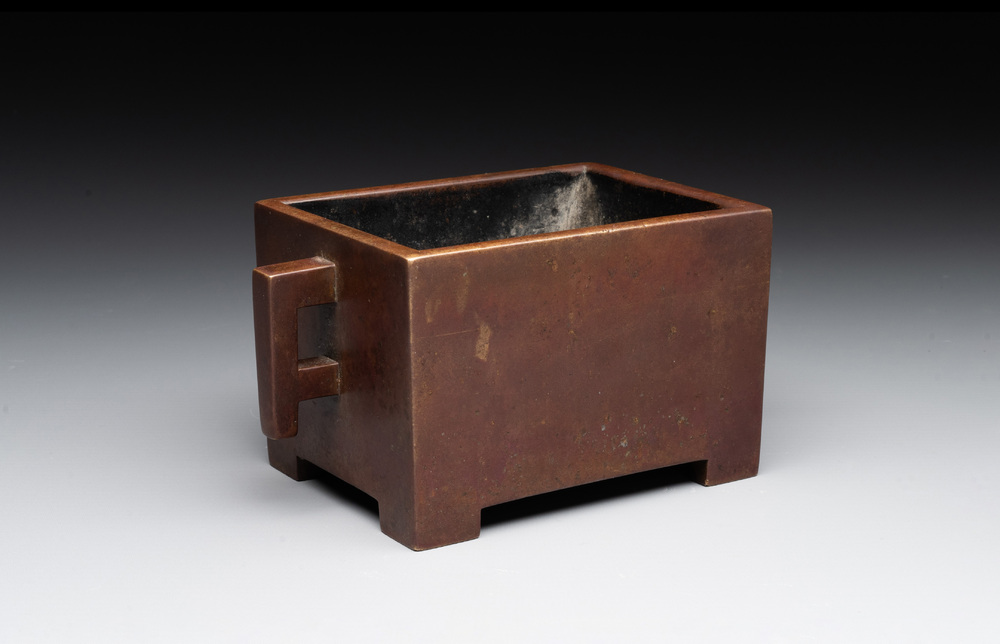
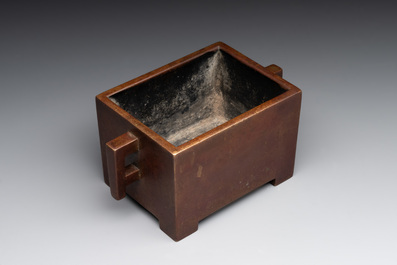
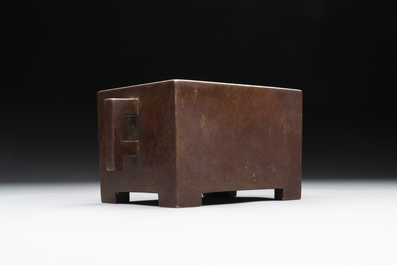
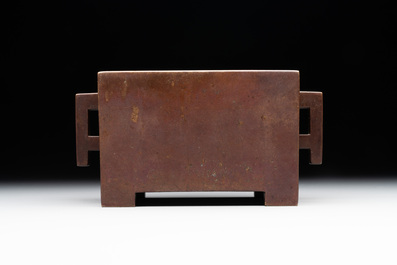
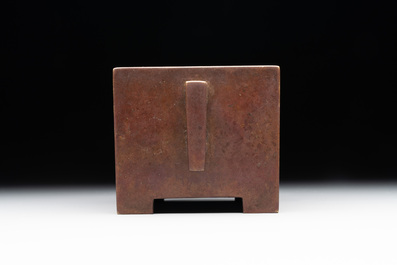
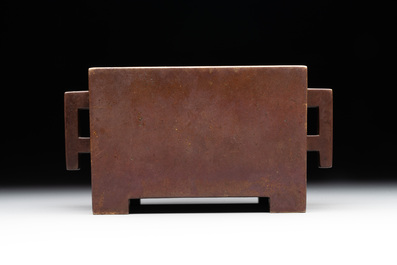
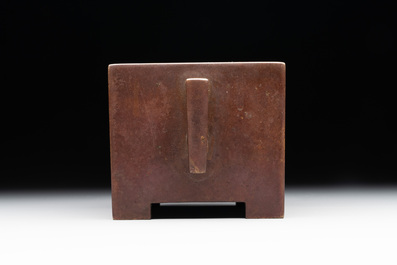
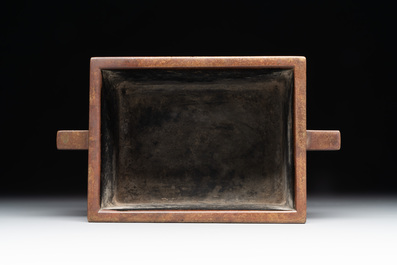
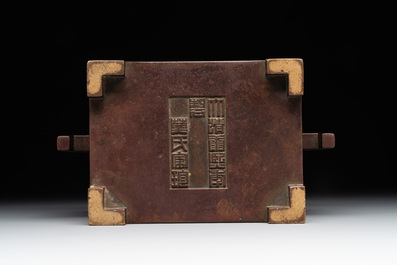
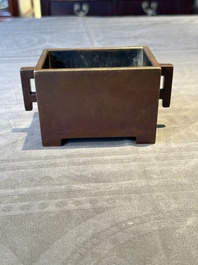
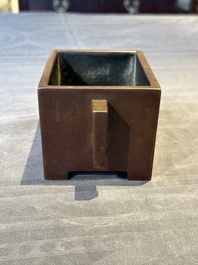
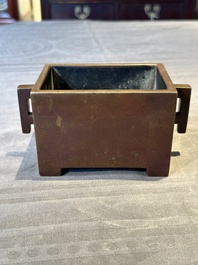
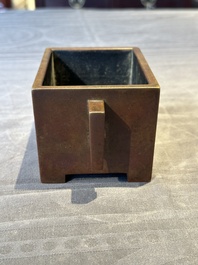
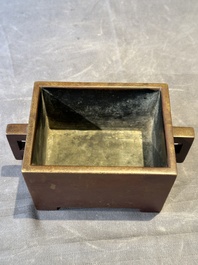
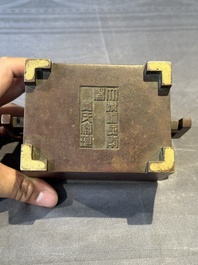
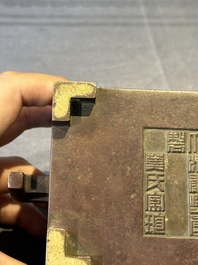
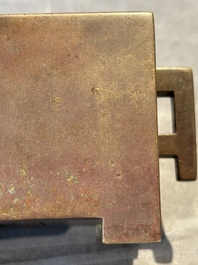
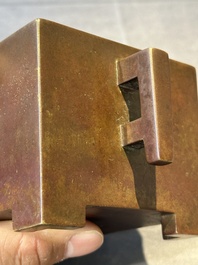
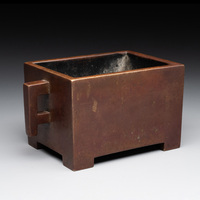
A rare Chinese rectangular bronze censer, Mo Shi Jia Zhen 莫氏家珍 mark, Kangxi mark and of the period
764
Dit lot werd verkocht op 2025-06-19 en is niet meer beschikbaar
Dim.: 15,8 x 8,9 x 7,8 cm (incl. handles)
Weight: 2161 grams
Provenance: An important Belgian private collection.
Mr. Wang Shixiang, in his book Zizhen Ji (Collection for Self-Appreciation), recorded the following about the inscription “Mo Chen Shi” (“莫臣氏”):
“Mo Chen,” whether used as a name or a pseudonym, conveys the sentiment of one who refuses to serve the ruling dynasty — akin to those who gathered herbs on Mount Shouyang.
In the Xuande period, inscriptions on bronze censers were typically used either to express personal ideals or as a commemorative gesture. Inscriptions like “Mo Chen Shi” and “Xian Xian Shi” (“獻賢氏”) are difficult to trace back to specific individuals or origins, yet they reflect the bearer's philosophy on life and approach to changing times — engraved directly onto the base of the censer. This reveals the scholar's practice of expressing personal ideals through objects and his cultivated taste for refined items, a sentiment that endures even after centuries.
The form of the ma cao lu (trough-shaped censer) derives from the taiji lu design illustrated in the Xuande Yi Qi Tu Pu(Illustrated Catalog of Ritual Vessels of the Xuande Era). According to the traditional cosmological concept of “heaven as round, earth as square,” square vessels were meant for earth-related rituals. Later generations simplified the ornate taiji lu, giving rise to the present form.
The ma cao lu has long been regarded as a vessel embodying integrity and uprightness. In addition to its ritual use, it was favored by scholars and often served as an elegant object for the scholar’s desk. The finest examples of this type were costly to produce and often custom-made for wealthy or official households. Hence the saying:
“Ma cao censers often bear private inscriptions, and those with private inscriptions are often fine pieces.”
王世襄先生在其《自珍集》一書中對於“莫臣氏”款有這樣一句記錄:“莫臣”,不論其為姓名或別號,皆有不食週栗之意。 採薇首陽者固代有其人也。 宣德爐刻款之目的無非明誌或留念兩種,款識諸如「莫臣氏」與「獻賢氏」類皆難以按圖索驍尋其淵源,卻將其為人處事之道與審時度勢之理念直接錒刻於銅爐 之底,更顯文人以物明志、雅好長物之情趣,歷經百年亦難以湮滅。 馬槽爐樣式,係由《宣德彝器圖譜》之台幾爐式衍化而成,按照「天圓地方」的宇宙觀,方爐為禮地之器,後世去台幾爐型之繁復,遂成 此器之形。 馬槽爐歷來被認為是方正耿直之器,因此除作禮器之用外也備受文人崇尚,多用作文房清供。 而其中品質精工者耗費頗奢,多為官宦富貴人家的定造之物,故有「馬槽多私款,私款多佳器」之說。
Conditierapport:
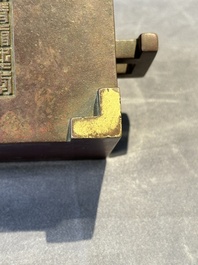
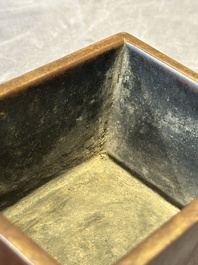
Condition: (UV-checked)- Generally in very good condition, with some normal wear and nice patination.
- A few minor superficial dents to the rim.
品相报告:(已用紫外线光检查)
- 整体品相非常良好,正常磨损,包浆浑厚。
- 爐口沿幾處非常輕微的凹痕。