


We have to double-check your registration and make sure this is not an automated entry in our system. Please complete the test below...
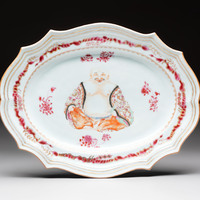
A rare Chinese lobed and inscribed armorial plate, Yang Bingguan 楊丙觀 mark, Qianlong, dated 1771
389
This lot was sold on 2025-06-19 and is no longer available
Dia.: 23,8 cm
Provenance:
- The private collection of Mr. Binder, son of J. Louis Binder, USA.
Reference:
- Bonham's New York, 'Cohen & Cohen: 50 Years of Chinese Export Porcelain', 24 January 2023, lot 36 for an identical example. (sold USD 3.187,50) (link)
The arms are unidentified but may be French. The signed and dated gilt eight-character inscription to the reverse naming the artist Yang Bingguan is highly unusual, as are the three-characters below the arms, which is most likely a transliteration of a Western family name or title.
Yang Bingguan (Pinqua, before 1747-1795), also known as Yang Cengong, is recorded as a porcelain dealer with over thirty-five years' experience who was appointed a Canton and Macao Hong merchant in 1782. The present lot was produced before the appointment, when he was running his firm Longhe Hang doing business with the European, such as the Dutch, Danish, Swedish, Spanish and British. His business continued after that appointment, reaching a peak around 1786-1789. However, the increase in revenues did not translate into the increase in profits; the heavy debts led to his bankruptcy in 1792. In 1793, Pinqua was arrested, and his properties were confiscated. In 1795, he was reported passed away while in custody at a Mandarin's house in Canton. (Paul A. Van Dyke, "Yang Pingqua: Merchant of Canton and Macao 1747-1795," in Review of Culture no. 62, 2020, pp. 62-89.)
The second ship to sail directly to China from America was the Grand Turk from Salem. The ship was owned by Elias Hasket Derby (1739-1799). The ships officers were presented a souvenir punchbowl by the Hong merchant Pinqua, decorated with a ship and a banner containing the legend "Ship Grand Turk / at Canton / 1786". Derby's son Elias Hasket Derby, Jr. (1766-1826) donated the bowl in 1800-1801 to the East India Marine Society, the forerunner of the Peabody Essex Museum. [Sargent 2012, no. 218, 401-401]
Reference: Howard, 2003, p. 598, a dinner plate with the arms of Drummond impaling Fane, circa 1793, also inscribed with Chinese characters to the reverse.
(Source: Cohen & Cohen, 'Think Pink!', 2013)
Price incl. premium:
€ 1.040