


We have to double-check your registration and make sure this is not an automated entry in our system. Please complete the test below...
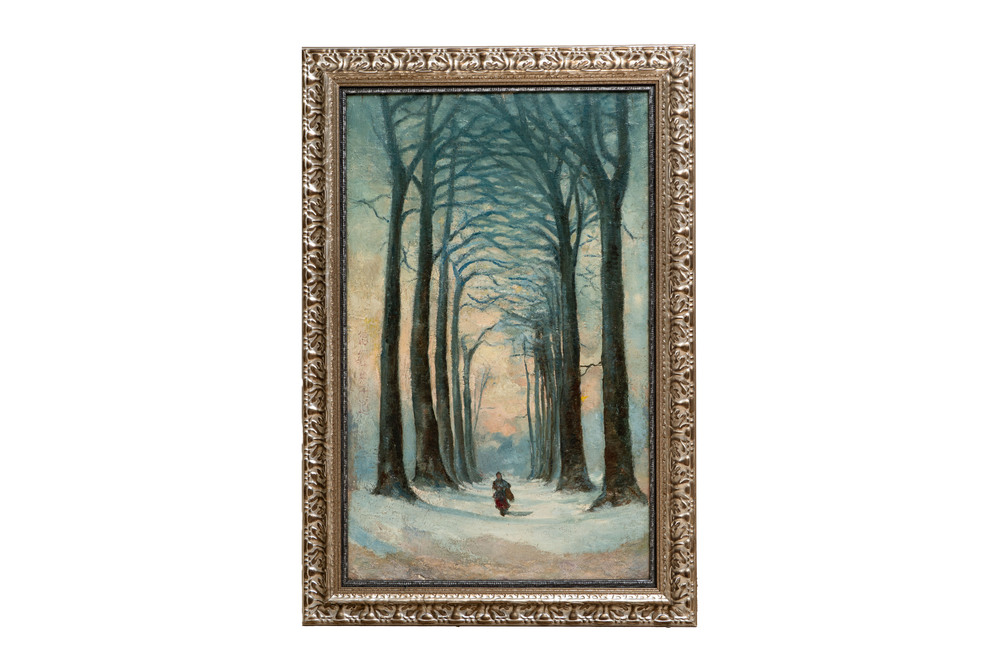
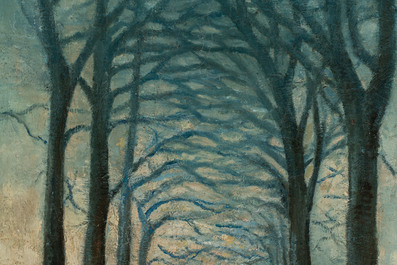
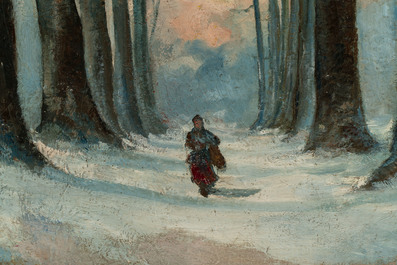
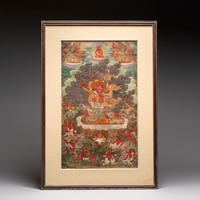
Attributed to Sadji or Sha Qi (Sha Yinnian 1914-2005): 'De Jing Wu Er Dao 德經無二道', oil on canvas, 20th C.
370
Dim.: 106,5 x 71,3 cm (the frame)
Dim.: 89 x 54 cm (the work)
Provenance: A Belgian private collection, Brussels.
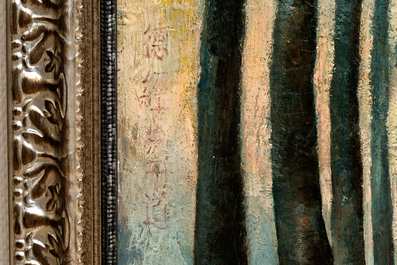
The vertical inscription on the left side of the painting reads: 'Dé Jīng Wú Èr Dào 德經無二道', meaning 'The way of virtue admits no second path.'
Sha Qi is known by many names: Born Sha Yinnian in the village of Sha, part of Yinxian County in Zhejiang, China (1932), he would also be dubbed Sad Ji in his European travels, and eventually called the Eastern Van Gogh by the end of his career. The intense beauty and tragedy that permeated his life and artwork was recognized during his early years, neglected in his later years, then fortunately rediscovered before his final days; so his prolific body of work continues to gain praise and excite the world of art today.
Sha Qi studied painting first at the Shanghai Arts School, then the Central University of China. His studies were interrupted, though, when Japanese armies invaded China. Sha Qi was not one to sit quietly by, and was arrested in 1933 after years of petitioning and demonstrations along with other Shanghai students. He spent a full year imprisoned by Kuomintang authorities, but after release he took a job at the Art Department of Central University in Nanjing. He worked then alongside his cousin and friend, Sha Menghai, who would go on to be a master calligrapher. It was at this same time Xu Beihong came into his life. Then Director of the Art Department, later to become President of Central Academy of Fine Arts (Beijing) and the Chinese Artists’ Association, Xu turned out to be a crucial guide and friend to Sha Qi, recognizing his talent and passion in art and spending the rest of their years together teaching, mentoring, promoting and protecting Sha. It was Xu that introduced Sha to the Belgium Royal Academy of Fine Arts, where he would learn Western painting under Professor A. Bastien (who also taught famous Chinese painter Wu Zuoren, 1908-1997).
With his excellent teachers, Sha Qi quickly found his way as an artist. In 1939, his grades in sketching, oil painting and sculpture classes won him a Golden Medal in Fine Arts. He held many solo shows in Brussels, and in 1940 he was showing alongside Pablo Picasso at Atriome. His painting titled “Girl Playing Flute” was purchased by the Royal Family of Belgium in 1942. During these years of study in Europe, Sha’s style developed from academically notable to stylistic, as exhibited in his painting “Studio at Royal Academy of Fine Arts”, one of the first to be accented by expressive brushstrokes that would soon become trademark of his work in Belgium. By the time he moved back to China in 1946, ‘Sad Ji’ was a well known and beloved artist in Europe. (source: Tobin Reese)
Estimate:
€ 8000
-
€ 12000